Posts

Dowdell, L. & Liew C. L. (2019) More than a shelter: Public libraries and the information needs of people experiencing homelessness. Library and Information Science Research v.41

Dowdell and Liew make the point that previous existing research regarding libraries and people experiencing homelessness does not cover the New Zealand context well, particularly in relation to their unique cultural context that includes the Maori and Pacific Island communities. Their goal for the paper is to examine the information seeking behaviours of people experiencing homelessness in a NZ library context to fill that gap. They set out to look at how this community are using public libraries to meet their information needs and how well the libraries are supporting their information needs. They hoped to understand how public library policies and practices could enable a more equitable and effective use of public libraries to meet their information needs. A barrier to this community in using public libraries described by the authors (identified in other research mentioned in their literature review) was that of a distrust of institutions, and the perceived inability of the community...

Seattle Public Library Programs for People Experiencing Homelessness

Image
This video explains some of the actions taken by the Seattle Public Library to meet the needs of communites without homes, including those living in 'encampments'. There are some parallels with the work being done by Yarra in the programs that take mobile internet hubs out to communities so they can use the internet for free.  My favourite line in this video is toward to start where the presenter says: "The libraray is an engine room for equality". I like this as as it recognises libraries ashaving a capacity to not only be places for everyone, but also as a place that can generate ideas, actions and processes that can support equality. I like the ideas of building, generating, creating and activating change that focus on equality. 

Barone, Mariekie, et al. "Developing a Model Policy for Public Libraries to Address Homelessness & Mental Illness." Delaware Journal of Public Health 6.4 (2020): 46.

Barone, Mariekie, et al. "Developing a Model Policy for Public Libraries to Address Homelessness & Mental Illness."  Delaware Journal of Public Health  6.4 (2020): 46. Although this article has a very American context, it is a useful publication in that in contains suggested content to include in a library policy regarding library users experiencing homelessness and mental illness - this will of course be sometimes the same people and sometimes not. The article gives some background into the needs of these communities and provides some brief case study notes of existing examples of collaborations between publuc libraries and homelessness and mental health service providers. This is followed by a section that lists and explains briefly what a policy should include: Purpose of Policy  A statement focused on how the specific policy will address the interface of libraries, homelessness and mental health. Specifically identifying areas of service needs, existing programmin...

American Libraries - Letter from Public Library Directors and Social Workers

https://americanlibrariesmagazine.org/blogs/the-scoop/letter-from-public-library-directors-and-social-workers/ This letter was written and signed by 12 American library directors and social workers and identifies some highlights of how they are working with their communities. These highlights are: Trauma-informed care Homelessness A focus on behaviour Creating welcoming spaces Person-first language It provides a great list of like-minded people in American libraries.

Adams, C., & Krtalić, M. (2021). I feel at home: Perspectives of homeless library customers on public library services and social inclusion.

  Adams, C., & Krtalić, M. (2021). I feel at home: Perspectives of homeless library customers on public library services and social inclusion.  Journal of Librarianship and Information Science , 09610006211053045. This is an interesting article as it has a New Zealand perspective - so not US, and allows the experiences of the people experiencing homelessness to be heard. These are the stated goals of the study reported in the paper: "The goal of this study was, therefore, to examine homeless patrons’ perspectives on public libraries, including their use of general library services and those targeted specifically toward the homeless, and in what ways engagement with library services affects their feelings of social inclusion. In doing so, this paper aims to contribute to the literature by offering insights into what constitutes effective public library programming and targeted services for homeless people." Page 1 This study interests me because it engages with the idea th...

Mariekie Barone, Stacie Fifelski, Alexandra Stocker, Thomas Worm, Ashley Patterson, Jessica Braamse, & Robert S. Lathers. Developing a Model Policy for Public Libraries to Address Homelessness & Mental Illness

Barone, M., Fifelski, S., Stocker, A., Worm, T., Patterson, A., Braamse, J., & Lathers, R. S. (2020). Developing a Model Policy for Public Libraries to Address Homelessness & Mental Illness.  Delaware Journal of Public Health ,  6 (4), 46. This US article describes a student project that set out to develop policy for libraries to frame their support of people experiencing homelessness and mental illness (interesting to lump these together). As part of their project they ran a survey that had 60 responses. Each library was asked:  What specific policies were in place that pertain directly to individuals experiencing homelessness?  What was the general experience of front line staff with the homeless population?  What type of training did they receive in this area? Did their branch(es) had a social worker on site and what community collaborations were in place to better serve the homeless population? One part of the article mentions -'a trauma-informed app...

Amanda Aykanian et al, (2020) Library-Based Field Placements: Meeting the Diverse Needs of Patrons, Including Those Experiencing Homelessness

 Amanda Aykanian, Peggy Morton, Kathi Trawver, Lane Victorson, Sarah Preskitt & Kimberly Street (2020) Library-Based Field Placements: Meeting the Diverse Needs of Patrons, Including Those Experiencing Homelessness , Journal of Social Work Education, 56 :sup1, S72-S80, DOI: 10.1080/10437797.2020.1723757 The abstract of this article makes the point that libraries are places that vulnerable people visit, and that librarians, like social workers are frequently advocates and supporters of these visitors. They then go on to say that librarians may not have the skills and knowledge to deal witht he complex needs of such people and that is where social workers come in handy.  The authors identify libraries as "second responders, stepping in when needed services are unavailable or inaccessible". The authors describe how libraries emerge as a reflection of their users' needs - they design programs, spaces and resources in response to the needs of the community they serve. But ...

Anderson, K.A., Simpson, C.D. & Fisher, G. (2012). 'The ability of public library staff to help homeless people in the United States: exploring relationships,roles and potential', Journal of Poverty and Social Justice, 20(2). 177-90

Interesting to see that in 2012 we were not using person-centred language - homeless patrons was the term used. People experiencing homelessness were described as having 'special needs', as having needs specifically relating to 'emotional and physical wellbeing'. They are described as presenting 'a range of needs and concerns', as having 'complex needs' and that they are a 'challenge' for librarians to work with. That these challenges are 'disruptive to library operations'. "Serving the needs of homeless people calls for library staff to be especially responsive, resourceful and creative."p.178. It will be interesting to see if this negative lens and discourse alters over time to recognise that maybe people experiencing homeless or insecure housing actually don't have needs specific to their accommodation status. Maybe they are not a 'challenge'. Maybe they just want what everyone else wants - somewhere quiet to sit ...

Importance of peer workers

Image
I often read about success stories where libraries have employed peer workers to be front-line staff at hteir branches. These workers can relate to people in the libraries and near the libraries and make them feel welcome when they may otherwise feel judged or excluded. This video is a great example of a peer worker in a public library in Denver, Colorado and the powerful influence she has on the community she works with. She is literally saving lives. Peer workers can benefit the library, its vulnerable users, and the peer worker themselves. When this works well, I can see no down-side.

Women's Butterfly Project

Image
  The Women's Butterfly Project is a project designed by the Queensland University of Technology and Griffith University in partnership with the QLD Department of Communities, Housing and Digital Economy, Q Shelter, Tenants Queensland, Mission Australia and a number of other partners. Their website can be accessed here:  https://research.qut.edu.au/best/projects/preventing-homelessness-for-mature-women-high-tech-vs-high-touch-support/   The premise of the project is to focus on women who are 55 or older, and to work with them BEFORE they become homeless, recognising that most programs and services associated with homelessness are focussed on people who are already homeless and/or impacted by long-term housing issues. The aim of the Project is to prevent homelessness before it occurs. The project connects vulnerable women with services and advice that can help them maintain their housing. The project is essentially toolkit collation of resources that are targetted at women...

The role of the user in the library - If you are not reading, you are not welcome?

Adams, C., & Krtalić, M. (2021). I feel at home: Perspectives of homeless library customers on public library services and social inclusion.  Journal of Librarianship and Information Science , 09610006211053045. This article raises an interesting point about that validity and level of acceptance and welcome experienced by library users may have a relationship to the activity they are undertaking while in the library. The participants in their study stated that sometimes they feel unwelcome in a public library if they are not reading. They are asked to move on if they are sleeping or not sitting in a chair.  " while Participant 7 was generally satisfied with library staff and services, he also explained that he sometimes felt discriminated against when staff questioned why he was sitting or lying on the floor instead of using a chair:  It seems like they pick and choose which ones to ask, you know what I mean? Yeah. If you’re not sitting there with a book, then, yeah (...

Day 2 with Yarra Libraries Outreach

Image
 On February 17, I spent a second day with the staff of Yarra Libraries and their outreach service. This time we were set up outside the injecting rooms at the Richmond higy-rise flats. As before we were sharing the space with other community service providers: OrangeSky was there with their laundry van again, and they also had a shower bus with them this time. There was also a presence from Ask Issy  which is a service that runs through mobile phones and connects people to services. The Ask Issy people were spruiking their site and were giving away phone charging banks.  It was very quiet, but all the staff from each of the services were saying that this quietness was really unusual and nothing like what had been the case before COVID. These days out in the community were the first in a long time since lockdowns had lifted. They suggested that the numbers would rise as they became more visible in the community and as word got around that the services were back in operati...

Ending homelessness in Australia: an evidence and policy deep dive

Image
I attended an online presentation on February 2, 2022 that launched this report which is a collaboration between the Centre for Social Impact, the University of New South Wales, the University of Western Australia, and Swinburne University. The presentation was spoken by Paul Flatau (Uni WA), Jessica Dobrovic (Advance to Zero -AtoZ), Karyn Walsh (Micah Projects), David Pearson (AAEH - Australian Alliance to End Homelessness) and Shane Jakupec (NEAMI International), and a person called Leigh who had been without a home for 20 years, but is now housed and working as an outreach worker. Apart from the report, which looks outstanding and can be accessed here:  https://apo.org.au/sites/default/files/resource-files/2022-02/apo-nid315326.pdf   I noted the following from the presentation: 70% of rough sleepers had periods of out of home care as children 36% had been in prison at some stage 20% had been in youth detention when younger People experiencing homelessness can find it very d...

Reflection on library outreach at Yarra Libraries

Image
I spent a couple of hours today with two staff from Yarra Libraries in one of their outreach projects where they set up at St Mark's in Fitzroy to distribute books, clothing and talk with community members who are visiting St Mark's to pick up food supplied by Anglicare. They also have an opportunity to wash their clothes with OrangeSky. The books that were given away were weeded from their own collections. It was very quiet, with about five people coming over to talk to the library staff. Each of them took some new clothes and some took some books either for themselves of for their children. The staff were saying that this was only their second time at St Mark's recently, although they had been there more regularly before COVID. They expect to build up their interactions over time.  They bought all their gear in a library van: Service partners: Yarra Libraries works with some partners to provide their services to the community. These are: Thread Together - for new clothin...

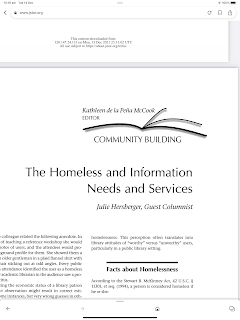
Hersberger, Julie. The homeless and Information needs and services

Image
  This article is old now but provides an interesting list of information needs of people experiencing homelessness So pretty much the same as everyone else. But it does make the point that these groups of people are not homogenous and their needs must be ascertained as men as any other user group. This is something I can help with working out what their needs are and what barriers exist that get in the way of libraries meeting those needs. Another important point is that libraries may not have all the answers to their information needs, but they should know who does so the role of information referral becomes very important. The author also makes the point that the difference between a library staff member providing a Service that makes the patron feel welcome or a nuisance is the attitude of the staff member.This is a good reason to work to understand Library staff attitudes as their feelings about working with homeless patrons is pivotal to the experience of the patron and in th...

Turn a Corner - Mobile library service for homeless in London

Image
This is an group running mobile library services to people experiencing homelessness in London. Interestingly, it is run by the Quakers! It would be good to spend some time with them if I can get to the UK in 2022.    This is their URL:  https://quakersocialaction.org.uk/we-can-help/homelessness-housing/turn-corner/how-turn-corner

Library Social Work presentation Simmons Uni Rachel Williams

Image
This was a great presentation by Rachel Williams about social work practices in libraries, particularly with regard to working with patrons who are experiencing homelessness. The presenter is Rachel Williams from Simmons University. These are the notes I took during the presentation: Rachel Williams - Professor at Simmons University rachel.williams@simmons.edu  Open to being contacted. New key term to consider apart from 'homeless' is 'unhoused'. One way to get library staff to talk about how they feel about working with people experiencing homelessness is to ask them to recount a time they have interacted with a person experiencing homelessness. Rachel referred to a lawsuit that would be interesting to look up - Richard Kreimer (USA) Idea: Look for mentions of 'equity of access' in library policies to see if they exist and what they say. Find: 'Invisible people' YouTube channel (Man interviews people experiencing homelessness) Find: Article by Provence ...

Discharge from psychiatric hospitals and prisons into homelessness

Nielssen, O. B., Stone, W., Jones, N. M., Challis, S., Nielssen, A., Elliott, G., ... & Large, M. M. (2018). Characteristics of people attending psychiatric clinics in inner Sydney homeless hostels .  Medical Journal of Australia ,  208 (4), 169-173. This research was mentioned during the podcast mentioned in an earlier post about rural and regional homelessness and mental health problems. I have tracked down this research and can see that it provides a study of people attending psychiatric clinics in inner Sydney homeless hostels. This is the abstract: Objective: To describe the characteristics of people attending mental health clinics at shelters for the homeless in inner city Sydney.  Design: Retrospective review of medical records of homeless hostel clinic attenders.  Setting: Mental health clinics located in three inner city homeless hostels.  Participants: Consecutive series of clinic attenders, 21 July 2008 e 31 December 2016.  Main outcome m...

Regional and rural homelessness podcast

This podcast is is from the Centre for Rural & Remote Mental Health and has guest speakers talking about homelessness in regional cities and in remote areas. Its focus is on NSW, but it will hild true for all parts of Australia.  The speakers are Tamara Pallos from Homelessness NSW, Penny Dordoy from Housing Plus, and Talie Star.  Talie currently facilitates the Domestic and Family Violence (DFV) Lived Experience Group with Homelessness NSW. One thing I learned from this is that there is a stream of people who leave psychiatric hospitals into homelessness. There were some stats mentioned that give a clue of the size of this. This could be used in an article about the characteristics of homelessness that libraries could be involved in.  One speaker (Penny?) mentioned that one of the greatest ways we can assist people experiencing homelessness is to give them connections back to their communities - to reduce their feelings of isolation and not belonging. Libraries could...

Cronin, B (2002). What a library is not. Library Journal v.127 (19), p. 46

Cronin, B (2002). What a library is not. Library Journal v. 127 (19), p. 46 This short article is not research, but is rather an opinion piece that posits that libraries are not places that should be offering anything beyond very traditional library services. The author provides a definition of a library from a dictionary that he then goes on to agree with and argues against any other roles for libraries. The definition he uses is:   "a place in which literary, musical, artistic, or reference materials...are kept for use but not for sale." He states that this definition is non-contentious. He goes on to elaborate in some strong language what a library is not: " A library is not a community masturbation center. A library is not a porn parlor. A library is not a refuge for the homeless. A library is not a place in which to defecate, fornicate, or micturate. A library is not a bathing facility. A library is not a dumping ground for latch-key children." He is not really...